No-Code AI Agents: Build Smart Web & Apps Without Developers in 2026
Published on: 23 May 2026
Imagine launching a fully functional, AI-powered mobile app or web platform without writing a single line of code. Sounds like science fiction? In 2026, it's not only possible—it's becoming the new normal. No-code AI agents are democratizing software development, putting the power of automation and artificial intelligence directly into the hands of business owners, marketers, and professionals. This paradigm shift is not just about saving money; it's about speed, agility, and the ability to experiment without the overhead of a traditional development team.
Learn more about our Website services
At EishwarITSolution, we've seen firsthand how this shift is reshaping the Indian digital landscape. Whether you're a small business owner in Mumbai looking to automate customer inquiries or a marketing head in Delhi wanting to build a personalized recommendation engine, no-code AI agents let you move from idea to deployment in days, not months. The tools have matured to the point where you can build sophisticated apps that handle natural language processing, image recognition, and complex decision trees—all through a visual interface.
In this guide, we'll explore what no-code AI agents are, why they matter for your business, and exactly how you can start building smart applications without a developer. We'll also dive into real-world examples from Indian industries, share expert tips, and address common pitfalls. Let's dive in.
Main Section 1: What Are No-Code AI Agents and Why They Matter in 2026
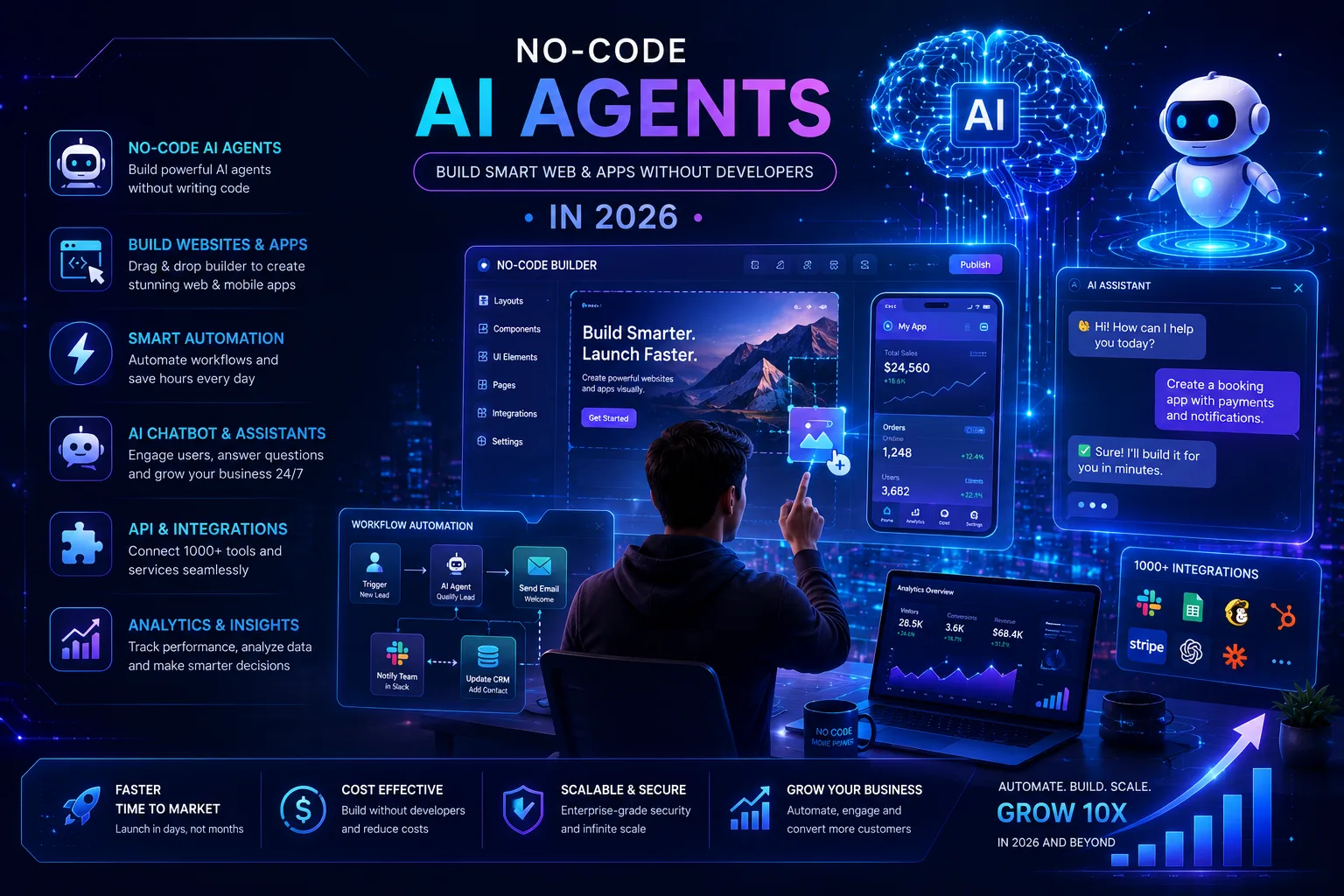
No-code AI agents are pre-built, drag-and-drop tools that allow non-technical users to create intelligent applications. These agents handle complex tasks like natural language processing (NLP), image recognition, predictive analytics, and workflow automation—all through a visual interface. Think of them as your digital workforce: you define the rules, provide the data, and the AI agent executes. In 2026, these platforms have matured to handle enterprise-grade workloads, making them accessible to businesses of all sizes.
The core difference between traditional no-code platforms and no-code AI agents is the intelligence layer. While earlier no-code tools focused on automating simple workflows (like sending emails or updating spreadsheets), modern AI agents can understand context, learn from interactions, and make decisions autonomously. For example, a no-code AI agent can analyze customer sentiment from a chat message and escalate the conversation to a human agent if frustration is detected—all without any manual programming.
Key Capabilities of Modern No-Code AI Agents
- Conversational AI: Build chatbots and voice assistants that understand context and emotion. These agents can handle multi-turn conversations, remember user preferences, and even switch languages mid-conversation. For instance, a customer might start a query in Hindi and seamlessly transition to English, with the agent maintaining context.
- Automated Workflows: Trigger actions based on user behavior, time, or external events. Imagine a workflow that automatically sends a personalized discount code to a user who abandons their shopping cart, then follows up with a reminder via WhatsApp if the code isn't used within 24 hours.
- Data Analysis & Predictions: Use built-in machine learning models to forecast sales, churn, or inventory needs. A small retailer in Chennai can feed historical sales data into a no-code AI agent and receive weekly predictions about which products will be in high demand, allowing them to optimize stock levels.
- Integration-Ready: Connect with popular tools like WhatsApp, Shopify, Google Sheets, and CRMs. Most platforms offer pre-built connectors, so you can link your AI agent to your existing tech stack without writing any code.
For Indian businesses, this is a game-changer. With a growing digital economy and a massive mobile-first user base, no-code AI agents let you compete with big tech without the big budget. According to a 2025 report by NASSCOM, Indian SMEs that adopted no-code AI tools saw an average 40% reduction in operational costs and a 25% increase in customer satisfaction within six months.
👉 Don't wait for the perfect moment; turn your vision into reality today.
Free ConsultationMain Section 2: Practical Steps to Build Your First No-Code AI App
Ready to build? Follow this actionable roadmap to create your first smart application using no-code AI agents. We'll use a practical example: building a lead qualification bot for a real estate agency in Pune.
Step 1: Define Your Business Problem
Start small. Ask yourself: What repetitive task eats up my team's time? Common examples include answering FAQs, qualifying leads, scheduling appointments, or personalizing email campaigns. For our real estate example, the problem is clear: the sales team spends hours on the phone asking basic questions like budget, location, and property type. An AI agent can handle this initial qualification, freeing up agents to focus on high-value activities like site visits and negotiations.
Step 2: Choose the Right Platform
Popular no-code AI platforms in 2026 include Bubble (with AI plugins), Zapier Central, Voiceflow, and Microsoft Power Platform (with Copilot). For Indian businesses, consider platforms with strong local language support and affordable pricing. Voiceflow, for instance, offers excellent support for Hindi, Tamil, and Marathi, making it ideal for regional businesses. Zapier Central is great for integrating with over 5,000 apps, while Bubble provides more flexibility for building custom web apps with AI capabilities.
When evaluating platforms, look for these features: a visual conversation builder, pre-trained NLP models for Indian languages, integration with popular Indian payment gateways (like Razorpay or Paytm), and compliance with the Digital Personal Data Protection Act (DPDPA).
Step 3: Design the User Flow
Use the platform's drag-and-drop builder to map out how users will interact with your app. For our real estate bot, the flow might look like this: the bot greets the user on WhatsApp, asks about their budget range, then asks for preferred locations (with options like Hinjewadi, Kharadi, or Baner), and finally asks about property type (apartment, villa, or plot). Based on the answers, the bot can either provide a list of available properties or schedule a call with a human agent.
Pro tip: Keep the flow linear and avoid too many branching paths. Users get frustrated if they have to answer more than 5-6 questions. Use conditional logic to skip irrelevant questions—for example, if a user says their budget is above ₹1 crore, don't ask about affordable housing options.
Step 4: Train Your AI Agent
Most no-code AI agents come with pre-trained models. You just need to feed them your data—like FAQs, product catalogs, or customer feedback. The more data you provide, the smarter your agent becomes. For our real estate bot, you would upload a spreadsheet with property details (price, location, size, amenities) and a list of common questions (e.g., "Is the property near a metro station?" or "What is the maintenance cost?").
👉 Free Website Audit
Get Free AuditTraining is an iterative process. Start with a small dataset (50-100 examples), test the agent, and then add more data based on the gaps you find. Many platforms offer a "training mode" where you can review conversations and correct the agent's responses. For instance, if the bot incorrectly answers a question about property taxes, you can manually correct it, and the platform will learn from that correction.
Step 5: Test, Launch, and Iterate
Launch a beta version to a small group—say, 10-20 users. Monitor performance using the platform's analytics dashboard. Look for metrics like conversation completion rate, user satisfaction scores, and drop-off points. For our real estate bot, you might find that users drop off at the budget question because the options are too limited. You can then expand the budget ranges or add a "Not sure" option.
Iteration is key. No-code platforms make it easy to tweak responses, add new questions, or change the flow without any downtime. After two weeks of testing, the Pune real estate agency saw a 50% reduction in time spent on initial lead qualification and a 30% increase in qualified leads.
For example, a Jaipur-based e-commerce store used a no-code AI agent to handle 80% of customer queries within two weeks, reducing support costs by 60%. They started with a simple FAQ bot and gradually added features like order tracking and return initiation.
Main Section 3: Real-World Use Cases Across Indian Industries
No-code AI agents are not just for tech startups. Here's how different sectors in India are leveraging them to drive tangible business outcomes.
Retail & E-commerce
Automate product recommendations, handle returns, and send personalized offers via WhatsApp. A small clothing brand in Surat built a chatbot that suggests outfits based on customer preferences—conversion rates jumped 35%. The bot asks users about their style (casual, formal, or ethnic), preferred colors, and budget, then curates a personalized lookbook. The brand also integrated the bot with its inventory system to show real-time availability.
Healthcare
Clinics use AI agents to schedule appointments, send reminders, and collect patient feedback. A dentist in Pune reduced no-shows by 50% with an automated reminder system. The bot sends a WhatsApp message 24 hours before the appointment, asks for confirmation, and allows rescheduling. If the patient doesn't respond, the bot sends a second reminder 2 hours before. The clinic also uses the bot to collect post-visit feedback, which helps improve service quality.
Education
EdTech platforms create AI tutors that answer student questions 24/7. A coaching center in Bangalore built a bot that explains math problems in multiple languages (English, Kannada, and Hindi). Students can type or speak their questions, and the bot provides step-by-step solutions. The bot also tracks which topics students struggle with, allowing teachers to focus on those areas in class.
👉 Free Homepage Demo
Book DemoReal Estate
Property agents automate lead qualification by having AI agents ask buyers about budget, location, and preferences before scheduling site visits. A real estate firm in Mumbai reported a 40% increase in conversion rates after implementing a no-code AI agent that pre-qualified leads and sent property recommendations via WhatsApp.
These examples show that no-code AI agents are versatile, scalable, and—most importantly—accessible to non-developers. The key is to start with a clear problem and choose the right platform for your needs.
Expert Tips
- Start with a single use case: Don't try to automate everything at once. Pick one pain point and solve it well. Once you see results, expand to other areas.
- Prioritize user experience: Even the smartest AI is useless if people find it confusing. Keep interactions natural and simple. Use conversational language, not robotic scripts. Test your bot with real users and iterate based on feedback.
- Monitor and optimize regularly: AI agents learn from data. Review conversations weekly and update your training data to improve accuracy. For example, if users keep asking a question your bot can't answer, add that question and response to the training set.
- Combine with human oversight: For complex queries, always have a fallback to a human. This builds trust and prevents frustration. Most platforms allow you to set up escalation rules—for instance, if the bot detects anger or confusion, it can transfer the conversation to a human agent.
- Leverage analytics: Most platforms offer dashboards. Use them to track user behavior, drop-off points, and conversion rates. This data is gold for optimizing your agent. For example, if you see a high drop-off at a particular question, consider rephrasing it or making it optional.
Common Mistakes
- Overcomplicating the flow: Too many branches and conditions confuse users and agents alike. Keep it simple. A linear flow with 5-7 questions is often more effective than a complex decision tree.
- Ignoring data privacy: Indian businesses must comply with the Digital Personal Data Protection Act. Ensure your AI agent handles data securely. Use platforms that offer end-to-end encryption and data localization. Also, be transparent with users about how their data is used.
- Not testing with real users: Internal testing is not enough. Get feedback from actual customers to find blind spots. You might think your bot is intuitive, but users may struggle with certain phrases or options.
- Underestimating maintenance: AI agents need updates as your business evolves. Set aside time monthly to review and refine. For example, if you add new products or services, update your bot's knowledge base accordingly.
- Choosing the wrong platform: Evaluate platforms based on your specific needs—not just popularity. Consider language support, pricing, and integrations. A platform that works well for a US-based business may not be ideal for an Indian audience that primarily uses WhatsApp and regional languages.
Future Trends
By 2027, no-code AI agents will become even more sophisticated. Expect multimodal agents that can understand text, voice, and images simultaneously. For example, a customer could send a photo of a damaged product, and the AI agent would automatically initiate a return process without any manual input. Hyper-personalization will be the norm, with agents adapting in real-time to user emotions and context. Indian startups are already experimenting with AI agents that speak 10+ regional languages fluently, using advanced NLP models trained on local dialects.
The next wave will include autonomous agents that can negotiate, upsell, and even complete transactions without human intervention. Imagine an AI agent that not only recommends a product but also negotiates the price within a predefined range and processes the payment—all through a chat interface. For businesses, the key is to start now. The longer you wait, the further behind you'll fall. Early adopters will have a significant competitive advantage as the technology evolves.
FAQs
1. Do I need any technical skills to use no-code AI agents?
No. Most platforms are designed for non-technical users. If you can use a spreadsheet, you can build an AI agent. The interfaces are visual, with drag-and-drop components and pre-built templates. However, a basic understanding of your business processes and user needs will help you design a more effective agent.
2. How much does it cost to build a no-code AI app?
Costs vary, but many platforms offer free tiers or plans starting at ₹1,000 per month. Enterprise features with advanced analytics, custom integrations, and higher usage limits can cost ₹10,000–₹50,000 per month. For most small businesses, a mid-tier plan (₹3,000–₹5,000 per month) is sufficient to handle thousands of conversations.
3. Can no-code AI agents handle complex tasks?
Yes, modern agents can manage multi-step workflows, integrate with APIs, and even perform simple machine learning tasks. For example, they can process natural language queries, analyze sentiment, and trigger actions based on user input. However, for highly specialized tasks like medical diagnosis or legal document review, you may still need custom development.
4. Are no-code AI agents secure?
Reputable platforms follow industry security standards like SOC 2, ISO 27001, and GDPR compliance. Always check their compliance with Indian data protection laws, specifically the Digital Personal Data Protection Act (DPDPA). Look for features like end-to-end encryption, data anonymization, and the ability to delete user data upon request.
5. How long does it take to build and launch an AI agent?
Simple agents can be built in a few hours using pre-built templates. More complex ones with custom workflows and extensive training data may take a week or two. The testing and iteration phase is crucial—plan for at least a week of beta testing with real users before a full launch.
6. Can I integrate my AI agent with existing tools?
Yes, most platforms offer integrations with WhatsApp, email, CRM (like Salesforce, Zoho), and popular business tools (like Google Sheets, Shopify, and Slack). Some platforms also provide API access for custom integrations. For Indian businesses, integration with WhatsApp Business API is particularly important, as WhatsApp is the most widely used messaging platform in the country.
7. What if my AI agent makes mistakes?
Continuous learning is built in. You can review conversations, correct errors, and retrain the agent to improve over time. Most platforms offer a "training mode" where you can flag incorrect responses and provide the correct answer. The agent will learn from these corrections and improve its accuracy. Additionally, you can set up confidence thresholds—if the agent is less than 80% confident in its response, it can escalate to a human.
8. Can no-code AI agents handle multiple languages?
Yes, many platforms support multiple languages, including Indian regional languages like Hindi, Tamil, Telugu, Bengali, and Marathi. Some platforms use Google Translate or Microsoft Translator for real-time translation, while others have built-in NLP models for specific languages. For the best user experience, choose a platform that offers native support for the languages your customers speak.
9. What kind of support can I expect from no-code AI platforms?
Most platforms offer documentation, video tutorials, and community forums. Some provide email or chat support, while premium plans include dedicated account managers. For Indian businesses, look for platforms with local support teams that understand the regional context and can provide assistance in Hindi or other languages.
10. How do I measure the success of my no-code AI agent?
Key metrics include conversation completion rate (percentage of conversations that end with a successful outcome), user satisfaction score (from post-conversation surveys), response accuracy (percentage of correct answers), and cost savings (reduction in human agent hours). Most platforms provide analytics dashboards that track these metrics. Set baseline metrics before launching your agent, and compare them after a month of use to measure impact.
Conclusion
No-code AI agents are not just a trend—they are a fundamental shift in how we build and deploy software. In 2026, business owners in India have an unprecedented opportunity to leverage AI without hiring a developer. The tools are here, the use cases are proven, and the competitive advantage is real. Whether you want to automate customer support, personalize marketing, or streamline operations, the path is clearer than ever. Don't wait for the perfect moment—start small, learn fast, and scale smart. The future of software development is no-code, and it's accessible to everyone.
CTA
Ready to build your first no-code AI app? Contact EishwarITSolution today for a free consultation. Our experts will help you choose the right platform, design your agent, and launch in record time. Let's automate your growth!